

If you want the short version, choose spotted gum for maximum natural character and durability, blackbutt for a lighter contemporary look, and merbau for a richer traditional tone, then let the site conditions decide whether that preference actually makes sense.
If you are choosing decking timber purely from three samples sitting on a supplier's counter, you are missing most of the decision.
A deck does not live indoors.
It sits through Melbourne sun, rain, cold mornings, hot afternoons and seasonal changes in moisture.
It gets walked on.
Furniture gets dragged across it.
Water runs between the boards.
Leaves collect around it.
Some decks sit close to damp ground.
Others sit above living rooms where getting the waterproofing wrong can become a much bigger problem than choosing the wrong shade of brown.
That is why the real question is not simply
Which timber looks best?
It is
Which timber makes the most sense for this deck, on this house, with the amount of maintenance you are realistically prepared to do?
For Melbourne homeowners choosing between spotted gum, blackbutt and merbau, all three can be very good options.
But they are not identical.
If you are already planning the project, you can see how Level A approaches deck construction across Melbourne before choosing the timber in isolation.
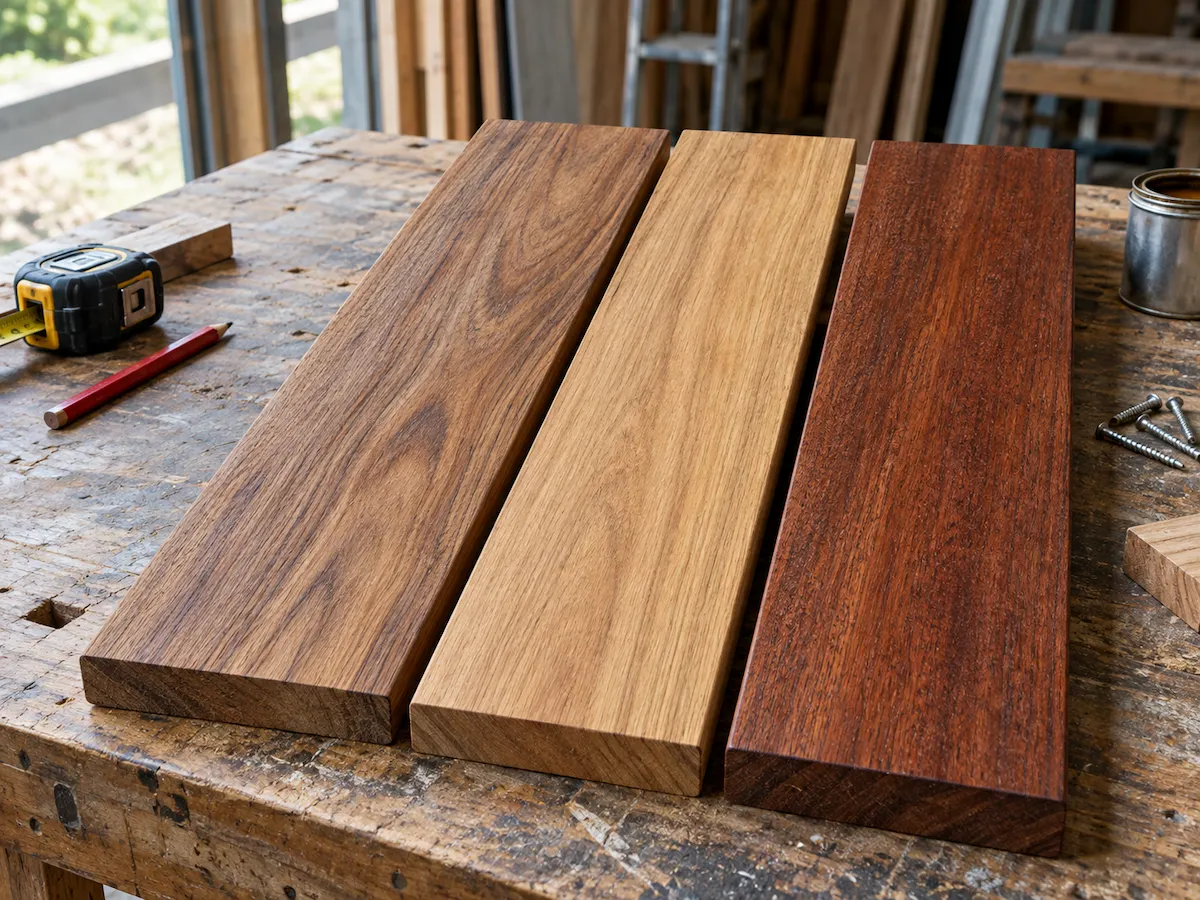
Spotted Gum, Blackbutt and Merbau at a Glance
Here is the practical comparison first.
| Spotted Gum | Blackbutt | Merbau | |
|---|---|---|---|
| Appearance | Highly varied pale brown to deep brown | Light golden to pale brown | Rich brown to reddish brown |
| Grain | Distinctive, often wavy | Generally straighter and more even | Generally straight with visible character |
| Density | Very high | High | High |
| Natural durability | Very high | High | Very high |
| Maintenance | Regular exterior timber maintenance | Regular exterior timber maintenance | Regular maintenance plus early tannin management |
| Best aesthetic fit | Natural, architectural, character-rich | Light, clean, contemporary | Warm, traditional, rich |
| Bushfire use | Suitable for relevant BAL applications when specified correctly | Suitable for relevant BAL applications when specified correctly | Suitable for relevant BAL applications when specified correctly |
| Main consideration | Colour variation is significant | Lighter colour and surface checking need consideration | Tannin bleed and sourcing need consideration |
That table tells you what is different.
It does not tell you which one belongs on your house.
For that, you need to go a little deeper.
Is Spotted Gum, Blackbutt or Merbau Actually Better?
There is no useful answer to this question without knowing the site.
If you tell Jake
“I want the most durable timber.”
that points the conversation one way.
If you say
“I want something light because the courtyard already feels dark.”
that may point it another way.
If your priority is
“I want rich timber against the red brick of our old Yarraville home.”
you may end up somewhere else again.
The species is one part of the specification.
Jake also needs to consider
- How exposed the deck will be
- How much direct sun it receives
- Whether it gets wind-driven rain
- How close it sits to ground
- Subfloor ventilation
- Existing framing
- Board width
- Drainage
- Fixings
- Whether it sits above a waterproofed area
- The architecture of the house
- How often you intend to maintain it
A very durable timber installed poorly can still become a disappointing deck.
A well-selected timber installed with the right spacing, drainage, ventilation, fixings and finish has a much better chance of performing the way you expect.
Spotted Gum Decking
Spotted gum is one of Australia's best-known premium hardwoods.
And visually, it is probably the most expressive of these three options.
Its colour can vary considerably from board to board.
You may see
- Pale browns
- Mid browns
- Deep chocolate tones
- Red-brown sections
- Stronger natural streaking
Its grain can also be wavy or interlocked.
That variation is part of the appeal.
If you want every board to look almost identical, spotted gum may not be your first choice.
If you want the timber to look unmistakably natural, it can be exceptional.
Why Is Spotted Gum So Popular for Decking?
Performance is a big reason.
WoodSolutions classifies spotted gum as a Class 1 above-ground durability timber, putting it in the very durable category for appropriate exterior applications.
It is also extremely dense.
That gives it a substantial feel underfoot and very good resistance to everyday wear.
It has long been used well beyond residential decking in structural and demanding exterior applications.
For a homeowner, the practical translation is simpler.
Spotted gum is a serious exterior hardwood.
That makes it particularly attractive for decks that are
- Highly exposed
- Heavily used
- Architecturally prominent
- Intended to remain part of the home for a long time
But durability still does not eliminate the need for good deck design.
Water must be able to leave.
Air must circulate.
Boards must have room to move.
Fixings must suit the environment.
A Class 1 timber does not compensate for water sitting beneath the deck for years.
What Does Spotted Gum Look Best With?
Spotted gum works particularly well when the house already contains natural materials.
Think
- Brick
- Render
- Concrete
- Black steel
- Natural stone
- Timber windows
- Warm interior flooring
Its variation can create an excellent transition between a highly resolved renovation and the garden.
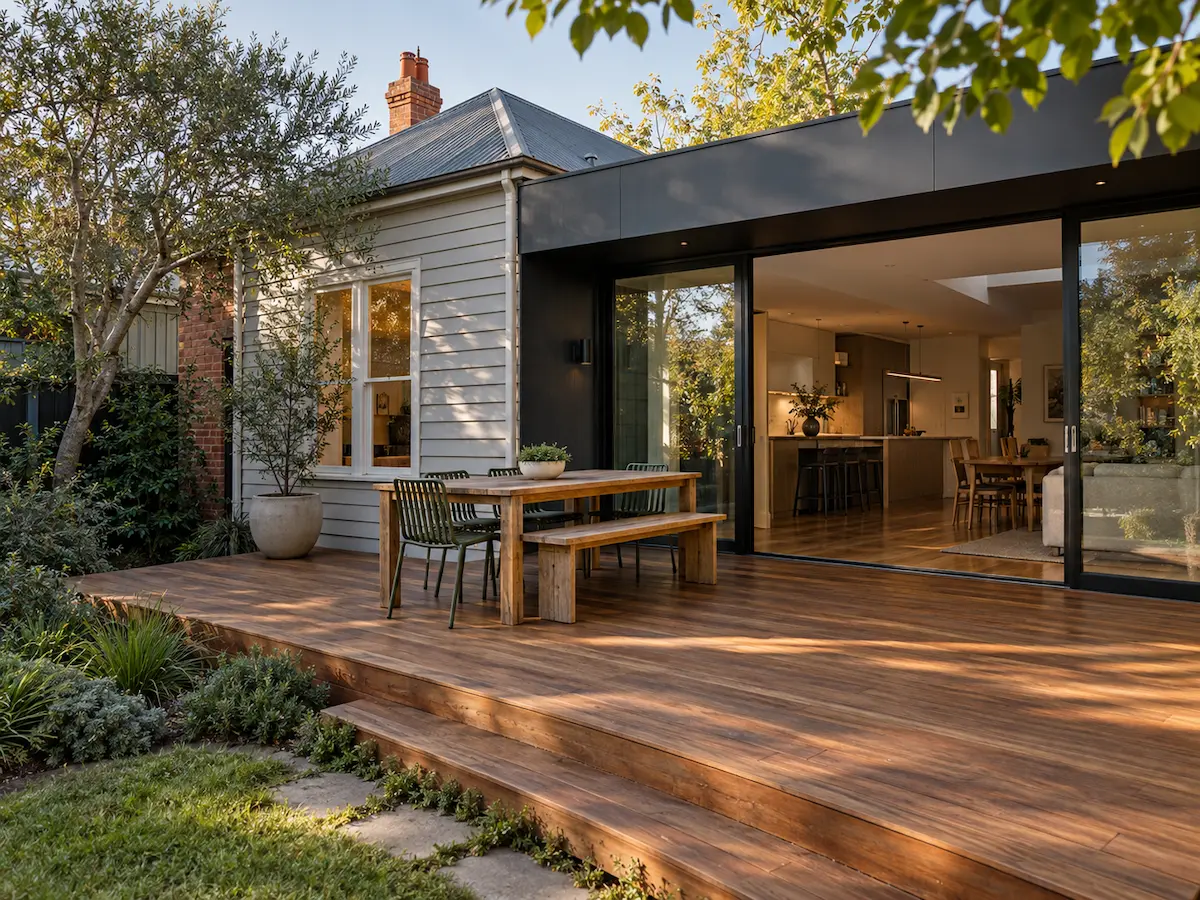
That makes it particularly effective on contemporary extensions attached to older Melbourne homes.
Rather than trying to make the rear addition look historical, the architecture can be contemporary while spotted gum provides enough natural warmth to stop the outdoor area feeling clinical.
What Is the Downside of Spotted Gum?
One person's feature can be another person's problem.
The biggest visual issue is variation.
A small timber sample does not represent an entire spotted gum deck.
One board may be considerably lighter than the next.
If you want a highly uniform surface, understand that before ordering it.
It is also a very hard and dense timber.
That is beneficial once installed, but experienced installation and appropriate fixing matter.
And like every natural timber exposed to Melbourne weather, the surface will change unless you maintain the finish.
Spotted gum is durable.
That does not mean maintenance-free.
Blackbutt Decking
Blackbutt gives you a very different look.
Where spotted gum often announces itself through variation and grain, blackbutt tends to be more restrained.
Its heartwood generally falls through
- Golden yellow
- Pale brown
- Light warm brown
- Occasional subtle pink tones
The grain is generally straighter.
The overall impression is lighter and cleaner.
That makes blackbutt particularly appealing in modern Melbourne renovations where the goal is to keep outdoor spaces bright.
Why Choose Blackbutt Instead of Spotted Gum?
Usually because you prefer the aesthetic.
Both are highly capable hardwood decking timbers when appropriately specified.
The biggest immediate difference homeowners notice is visual.
Imagine a modern extension with
- White or warm-neutral render
- Large black-framed doors
- Pale interior oak
- Minimal landscaping
- Simple contemporary furniture
Spotted gum creates more contrast and natural variation.
Blackbutt can create a calmer transition.
Neither is objectively better.
They produce different architecture.
Is Blackbutt Durable Enough for Melbourne Decking?
Yes, when properly selected and detailed for the application.
Current WoodSolutions general durability guidance places blackbutt heartwood in Durability Class 2, which is still considered durable and suitable for exposed above-ground applications when specified correctly.
That is an important distinction.
You do not need to automatically choose the highest durability class available.
You need the appropriate durability for the application.
Drainage, ventilation, board installation, finishes and ongoing maintenance still matter enormously.
Does Blackbutt Work in Bushfire Areas?
Blackbutt is one of the Australian hardwoods with established bushfire applications.
WoodSolutions identifies suitable uses through BAL 12.5, BAL 19 and BAL 29 where the timber and construction satisfy the applicable AS 3959 requirements.
That does not mean every blackbutt deck automatically complies.
Bushfire construction is about the complete specification.
The property BAL rating, dimensions, location and detailing still need to be considered for the actual project.
The same principle applies to spotted gum and merbau.
What Is the Downside of Blackbutt?
Blackbutt needs the same respect for moisture and movement as other exterior timber.
It can also develop surface checking.
Small surface checks do not necessarily mean structural failure, but homeowners expecting a perfectly furniture-like timber surface forever need realistic expectations about what an exterior deck actually does.
Timber lives outside.
It gets wet.
It gets hot.
It dries.
It moves.
The objective is not to pretend this will never happen.
The objective is to choose, detail and maintain the timber appropriately so those natural behaviours remain controlled.
Merbau Decking
Merbau has been used for Australian decks for decades.
For many homeowners, it is what a timber deck looks like in their head.
It tends to have a richer brown or reddish-brown appearance than blackbutt and often feels more visually uniform than highly varied spotted gum.
It is also a strong, naturally durable hardwood.
So why does it sometimes receive less attention in premium architectural projects?
Part of the answer is aesthetics.
Part is tannins.
And part is responsible sourcing.
Is Merbau Still a Good Decking Timber?
Yes.
From a performance perspective, merbau remains a highly capable exterior timber.
WoodSolutions identifies it as naturally durable and suitable for exterior construction, including decking.
It is also termite resistant.
It has established bushfire-resisting applications through BAL 12.5, 19 and 29 when the relevant AS 3959 requirements are met.
So the argument against merbau should not be
“It is an inferior timber.”
That is too simplistic.
The better question is whether its appearance and particular characteristics suit the project.
The Biggest Issue With Merbau Is Tannin Bleed
Merbau contains natural extractives.
When new merbau gets wet, those extractives can leach from the timber and create brown or reddish staining.
That matters particularly when the deck is adjacent to
- Pale render
- Light paving
- Concrete
- Pool surrounds
- Light masonry
- Painted surfaces
The timber can still be perfectly sound while the runoff creates a cosmetic problem around it.
Good preparation and detailing can substantially reduce this risk.
But it should be discussed before the deck goes down.
Not after the first heavy rain leaves marks below it.
Merbau Also Has a Sourcing Question
This deserves more attention than most decking comparisons give it.
Merbau comes primarily from tropical forests in Southeast Asia, Papua New Guinea and Pacific regions, with some Australian supply.
WoodSolutions specifically recommends checking sourcing because merbau can come from regions where forestry controls differ.
Certified merbau is available in Australia.
If you choose merbau, ask the supplier about credible certification and chain of custody.
That is a much better approach than assuming all merbau is either responsibly sourced or irresponsibly sourced.
The source matters.
Spotted Gum vs Blackbutt
This is probably the comparison Jake is most likely to have with a homeowner looking at premium Australian hardwoods.
The decision can often be reduced to this.
Choose spotted gum if you prefer
- Strong natural variation
- Darker and more varied tones
- Distinctive grain
- Very high natural durability
- A strong Australian hardwood character
Choose blackbutt if you prefer
- Lighter tones
- Straighter grain
- A more uniform visual field
- Contemporary architecture
- A bright outdoor space
Performance matters.
But when both are appropriate for the site, this becomes heavily aesthetic.
You have to look at the timber against the house.
Not against another timber sample.
Spotted Gum vs Merbau
These two can both deliver deep natural colour, but they feel very different.
Spotted gum usually presents greater board-to-board variation.
Merbau generally gives a richer and more familiar reddish-brown deck appearance.
Spotted gum gives you
- Australian hardwood
- Very high natural durability
- Distinctive grain
- More colour variation
Merbau gives you
- High natural durability
- Strong exterior performance
- Rich warm colour
- Generally good dimensional stability
- Often broad availability
Merbau adds two considerations.
Tannin management.
Responsible sourcing.
If those are dealt with properly, it remains a legitimate high-performance decking option.
Blackbutt vs Merbau
This is perhaps the clearest visual contrast of all three.
Blackbutt is generally light.
Merbau is generally dark and warm.
If the deck sits beside a small courtyard or under a covered alfresco area, that difference can substantially affect how the space feels.
Light decking can help an already enclosed space feel brighter.
Dark timber can bring warmth and grounding to large or pale architecture.
There is no universal answer.
Architecture decides a lot here.
Which Timber Is Lowest Maintenance?
None of them are maintenance-free.
That point is worth making clearly.
Natural exterior timber changes under UV and weather.
If you want to preserve a freshly oiled timber appearance, you will need to clean and recoat it periodically.
WoodSolutions notes that decking oils and stains commonly require reapplication over time, with the actual interval depending on the finish and exposure.
So instead of asking
Which timber needs no maintenance?
ask
How do I want this deck to look in five years?
There are two broad approaches.
Maintain the original colour
Clean the deck and maintain the coating system at appropriate intervals.
This keeps more of the warm timber colour.
Let it weather naturally
Some homeowners are comfortable allowing natural timber to grey as it ages.
That does not mean you simply ignore the deck.
Drainage, fixings, cleanliness and structural condition still need monitoring.
But you may accept surface weathering rather than continually chasing the freshly oiled appearance.
That conversation should happen before the species is selected.
Does a More Durable Timber Mean Less Maintenance?
Not necessarily.
This is an important distinction.
Durability describes how well the timber's heartwood resists biological deterioration such as decay.
Surface appearance is different.
A highly durable hardwood can still
- Grey
- Develop small checks
- Lose coating
- Pick up stains
- Change colour
Spotted gum's Class 1 durability does not mean it will look freshly installed indefinitely.
The deck can remain structurally capable while the visible surface changes.
That is why maintenance expectations need to be separated into two questions.
How long should the timber perform?
and
How do you want it to look while it performs?
What Actually Makes a Timber Deck Last?
Species gets most of the attention.
Construction detailing deserves just as much.
WoodSolutions' decking guidance emphasises drainage, ventilation, appropriate timber durability, correct board spacing and suitable fixings as fundamental to long-term deck performance.
Jake is looking at the whole system.
Drainage
Water should not sit against timber unnecessarily.
The deck needs to shed water.
The ground underneath also needs to be considered.
Ventilation
Timber performs better when it can dry.
A very low deck with almost no airflow below it is a different environment from an elevated deck with open ventilation on multiple sides.
That can influence the entire design.
Board Spacing
Boards need room for seasonal movement and drainage.
The correct installation gap depends partly on whether the timber is seasoned or unseasoned and its moisture condition when installed.
This should be specified rather than guessed.
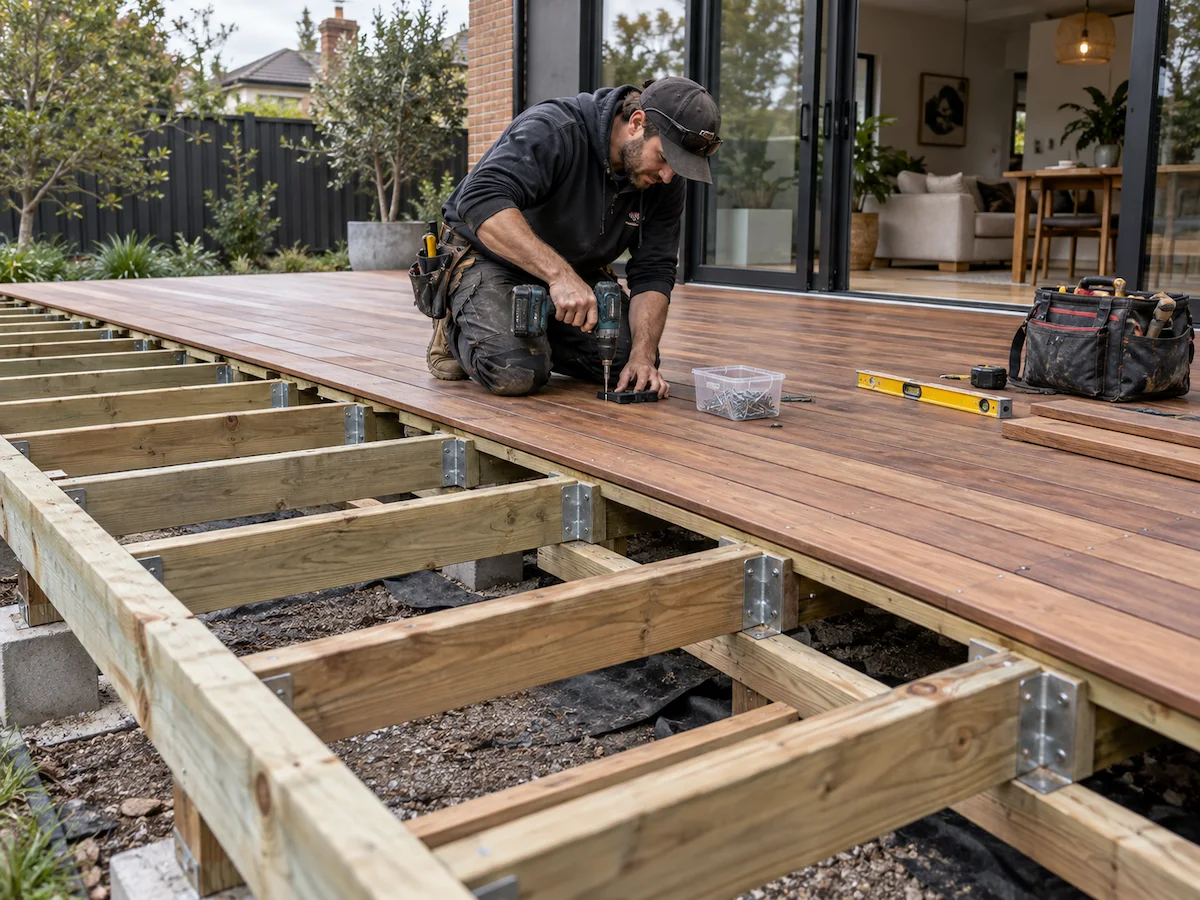
Fixings
The fastener is part of the deck.
Fixing choice needs to suit
- Timber species
- Board size
- Subframe
- Exposure
- Coastal conditions
Near the bay, corrosion resistance becomes especially important.
A premium hardwood deck with poorly selected fixings is not a premium deck.
End Grain and Cut Surfaces
Cut ends deserve protection.
End grain absorbs moisture more readily than the face of the board, which is why appropriate sealing and detailing of cut ends matters in exterior timber work.
These are small details when the deck is being built.
They become important details after years outside.
Why Wider Decking Boards Are Not Automatically Better
Wide boards can look beautiful.
They create fewer lines and a more substantial appearance.
But timber moves across its width.
That means board dimension affects movement.
Wider boards can require more careful control of
- Moisture
- Fixing
- Ventilation
- Spacing
- Species selection
Sometimes the narrower board produces the better long-term outcome.
The decision should be made as part of the deck specification rather than simply because the wider profile looks more expensive in the showroom.
What About the Subframe?
Homeowners understandably focus on the boards because that is what they see.
Jake is often more interested initially in what sits underneath them.
A deck is a structure.
The visible timber is supported by
- Bearers
- Joists
- Posts
- Connections
- Footings
On an existing deck, those elements need assessment before deciding that replacing the boards is enough.
There is little value putting $15,000 worth of premium hardwood over framing that is already deteriorating.
An existing inspection might reveal
- Rotten joists
- Poor drainage
- Termite damage
- Undersized framing
- Inadequate bracing
- Rusting fixings
- Previous patch repairs
- Insufficient ventilation
- Movement at the connection to the house
Sometimes the boards are the problem.
Sometimes they are simply hiding the problem.
Decking Over a Balcony Is a Different Conversation
A ground-level backyard deck and a balcony over a bedroom should not be treated as the same project.
If there is habitable space below, water management becomes critical.
The timber decking is only the walking surface.
Below it may be a waterproofing system responsible for keeping the building dry.
That means the design needs to consider
- Falls
- Drainage
- Membranes
- Thresholds
- Flashings
- Penetrations
- Deck supports
- Access for maintenance
Current Victorian building guidance continues to treat water management and exposed balcony surfaces as important building-envelope issues.
Jake's qualification in both carpentry and waterproofing is particularly useful here because he can look at the decking and water-management system together.
The discussion is not merely
Which board goes on top?
It is
How does this entire assembly get wet and then safely get dry again?
Never Choose Balcony Timber Before Understanding the Waterproofing
A timber sample will not tell you
- Where the drains are
- Whether falls are adequate
- How the membrane terminates
- Whether balustrade penetrations are correctly detailed
- How the decking support system interacts with the membrane
- Whether water can be trapped beneath the boards
Those issues can matter far more than whether you choose spotted gum or blackbutt.
This is why a balcony inspection needs to start underneath the visible finish.
Which Decking Is Best for Brighton?
There is no official “Brighton timber.”
But the environment changes what Jake pays attention to.
Bayside projects can mean
- Greater wind exposure
- Wind-driven rain
- Strong sun
- Salt-laden air
- More exposed fixings
- High-value adjoining finishes
That makes detailing especially important.
For a highly exposed Brighton deck, spotted gum may be attractive because of its excellent natural durability and substantial hardness.
Blackbutt is equally worth considering where the architecture calls for a lighter contemporary timber.
Merbau can also perform well, particularly on more protected decks, but tannin runoff needs consideration where there are light rendered walls, paving or other easily stained surfaces.
The choice should follow the house.
Not the postcode.
You can see Level A's broader renovation and carpentry work in Brighton.
Which Decking Is Best for Essendon?
Essendon gives Jake a different mix of properties.
You might have
- Californian bungalow
- Period brick home
- Post-war house
- Contemporary rebuild
- Modern extension attached to an older home
That creates far more aesthetic variation.
A blackbutt deck can work beautifully with a light contemporary rear renovation.
Spotted gum can introduce stronger natural character against masonry or dark metalwork.
Merbau can create a warm, traditional appearance where richer timber tones make sense.
On sheltered sites, the difference between species may be less important than
- Existing subfloor condition
- Ventilation
- Sun exposure
- Board profile
- Maintenance preference
See more about Level A's work across Essendon.
What About Character Homes in Melbourne's Inner West?
Older Melbourne homes create another set of considerations.
The existing verandah or deck may be attached to framing that has already seen multiple generations of repair.
You may also have
- Narrow side access
- Low subfloor clearance
- Old brickwork
- Period detailing
- Existing drainage problems
- Earlier extensions
Spotted gum can create a striking connection between an old house and a contemporary rear addition.
Blackbutt can lighten a compact courtyard.
Merbau's warmer tone can work well alongside heritage brick and traditional detailing.
Again, the species decision comes after the site decision.
Does Spotted Gum Cost More Than Merbau?
Often, but not always.
Timber pricing moves.
It depends on
- Supplier
- Grade
- Board profile
- Width
- Thickness
- Availability
- Certification
- Quantity
- Whether timber is prefinished
That is why quoting a permanent per-square-metre price in a timber comparison article is not particularly useful.
The material is also only one part of what you are paying for.
Your deck price can include
- Demolition
- Disposal
- Footings
- Posts
- Bearers
- Joists
- Structural connections
- Stairs
- Balustrades
- Waterproofing
- Decking
- Fixings
- Finishing
- Access
- Site preparation
A cheaper decking board does not automatically produce a dramatically cheaper completed deck.
If you want to understand how Level A scopes these projects, see the Melbourne decking service.
Is Paying More for Spotted Gum Worth It?
It can be.
But only if the reason for paying more aligns with what you value.
Paying more makes sense if you specifically want
- Its natural variation
- Its Australian hardwood character
- Its high density
- Its very high natural durability
- The architectural appearance
It makes less sense if you actually prefer blackbutt's lighter appearance.
Buying the timber with the strongest specification sheet while wishing it looked like another species is not a good material decision.
You have to live with the deck.
Can Spotted Gum, Blackbutt and Merbau Be Used in Bushfire Areas?
All three have documented bushfire-resisting applications.
Current WoodSolutions material identifies spotted gum, blackbutt and kwila, another common name for merbau, among bushfire-resisting timbers used in relevant applications through BAL 29.
But this needs an important qualification.
A bushfire-resistant timber does not make a deck automatically compliant.
The BAL rating of the property, board dimensions, gaps, substructure, proximity to glazing and other construction details all matter.
If bushfire construction applies to the property, the deck should be specified for that particular site.
Do not select a timber from a BAL label alone.
Do All Three Resist Termites?
The heartwood of all three species has recognised termite resistance.
But another distinction matters.
Durability ratings primarily refer to heartwood.
Sapwood is different.
WoodSolutions specifically notes that sapwood should be treated appropriately when used in exposed applications because it does not inherit the natural durability rating of the heartwood.
Again, board quality and sourcing matter.
The species name on an invoice is not the whole specification.
What Jake Looks at Before Recommending Decking Timber
When Jake visits a property, the decision should not begin with
“Which of these three colours do you like?”
He first needs to understand where the deck is going.
Exposure
How much rain reaches it?
How much direct sun?
Is it protected by a roof?
Does wind drive rain under the cover?
Drainage
Where does water go?
Can the area below the deck drain?
Is there anything that can hold moisture underneath?
Ventilation
How much airflow exists around the deck?
Is it low to ground?
Is the subfloor enclosed?
Existing Structure
If this is a replacement deck
- Are the joists sound?
- Are the bearers sound?
- Is there movement?
- Are connections adequate?
- Is there previous water damage?
Waterproofing
Does the deck sit over habitable space?
Are there existing membranes?
How are thresholds and drainage detailed?
Architecture
What is the house made from?
What timber tones already exist?
Does the client want the deck to blend in or become a feature?
Maintenance
This is one of the most important questions.
How much maintenance are you genuinely prepared to do?
Not how much maintenance you imagine doing during the excitement of a renovation.
How much will you still be prepared to do four years later?
That answer can affect the finish, colour expectations and ultimately the species choice.
The Best Decking Timber Depends on the Homeowner Too
There is no technical table that can answer every part of this decision.
Two people can own identical houses and reasonably choose different timbers.
One might say
I love colour variation. I want it to look unmistakably like natural Australian timber.
Spotted gum immediately becomes interesting.
Another might say
The courtyard is small and dark. I want it as light as possible.
Blackbutt deserves serious attention.
Another might say
I love deep brown timber and I am happy to manage the tannins properly.
Merbau can make complete sense.
Good material specification combines technical suitability with what the homeowner actually wants to live with.
Spotted Gum vs Blackbutt vs Merbau Decision Matrix
| If Your Priority Is | First Timber to Consider | Why |
|---|---|---|
| Maximum natural durability | Spotted Gum | Class 1 above-ground durability and very high density |
| Light contemporary appearance | Blackbutt | Golden to pale-brown tones and relatively straight grain |
| Rich traditional colour | Merbau | Deep warm brown appearance |
| Strong natural variation | Spotted Gum | Considerable board-to-board colour and grain variation |
| More uniform visual character | Blackbutt | Generally cleaner and straighter appearance |
| Character-home warmth | Merbau or Spotted Gum | Both can work strongly against brick and period materials |
| Exposed architectural deck | Spotted Gum or Blackbutt | Strong exterior performance with different visual outcomes |
| Bushfire-relevant specification | All three may be suitable | Must be detailed for the site's actual BAL requirements |
| Light paving directly below | Spotted Gum or Blackbutt may simplify staining management | New merbau requires particular attention to tannin runoff |
| Responsible imported timber sourcing | Certified Merbau only | Check credible certification and chain of custody |
This is a decision guide.
Not a substitute for looking at the actual property.
What I Would Choose in Three Different Melbourne Homes
Here is the simplest way to understand the decision.
Exposed Brighton rear deck
Large contemporary renovation.
Strong sun.
Some wind-driven rain.
Natural stone and dark metalwork.
Homeowner likes visible timber variation.
Spotted gum would be high on the shortlist.
Not simply because Brighton is coastal.
Because the combination of high durability, density and stronger natural character fits the brief.
Sheltered Essendon courtyard
Contemporary rear addition.
Space is relatively compact.
Light interiors.
Homeowner wants clean lines and a bright outdoor area.
Blackbutt would deserve serious consideration.
Its lighter tone can help the courtyard remain visually open.
Character-home verandah
Red brick.
Older architecture.
Protected exposure.
Homeowner prefers deeper, traditional timber colour.
Merbau could work extremely well.
The tannin issue needs managing and the supply should be responsibly sourced.
But there is no reason to dismiss it simply because Australian hardwoods are currently more fashionable in high-end renovations.
The correct material is the one that works.
Five Mistakes to Avoid When Choosing Hardwood Decking
1. Choosing from one small sample
Natural timber varies.
Particularly spotted gum.
Look at a larger range of boards if colour consistency matters to you.
2. Assuming the most durable species is automatically best
Durability matters.
So do architecture, exposure, detailing, maintenance and budget.
3. Ignoring everything below the boards
The subframe, drainage and ventilation are part of the deck.
Not background details.
4. Forgetting that exterior timber changes
UV, water and time will change the appearance.
Decide whether you want to maintain the original colour or accept natural weathering.
5. Treating waterproofing and decking as separate projects
Especially on balconies.
Someone needs to understand how the two systems interact.
That is one reason Jake's combination of carpentry and waterproofing experience is valuable on more complex outdoor projects.
Why the Cheapest Decking Quote Is Difficult to Compare
Imagine three quotes.
All say
30 square metre hardwood deck.
That does not mean they contain the same thing.
One might assume
- Existing frame retained
- Merbau boards
- Basic fixing system
- No structural repairs
- No waterproofing
- No stairs
Another might include
- New structural frame
- Spotted gum
- Premium corrosion-resistant fixings
- New stairs
- Drainage improvements
- Waterproofing work
- Finishing
The price difference may have less to do with builder margin than completely different scopes.
Before comparing totals, compare
- Timber species
- Grade
- Profile
- Subframe
- Fixings
- Structural work
- Waterproofing
- Finishing
- Demolition
- Disposal
- Stairs
- Balustrades
- Access
- Maintenance treatment
That is where meaningful comparison starts.
How Level A Builders Approaches Decking Projects
Level A Builders does not need every homeowner to choose the most expensive hardwood.
The objective is to specify the deck properly.
Jake is a qualified carpenter and qualified waterproofer, and clients deal directly with him from the initial site conversation through the project.
That becomes particularly valuable where decking intersects with
- Existing structural framing
- House connections
- Balconies
- Waterproofing
- Thresholds
- Outdoor living renovations
The project starts by defining the actual scope rather than forcing a standard deck package onto every property.
You can learn more about Jake and Level A Builders, or browse the Level A project gallery to see more of the workmanship and renovation approach.
Frequently Asked Questions About Spotted Gum, Blackbutt and Merbau
Is spotted gum better than blackbutt for decking?
Not universally.
Spotted gum offers very high natural durability and greater colour variation.
Blackbutt offers high durability with a generally lighter, straighter appearance.
When both suit the site technically, architecture and visual preference can decide the choice.
Is spotted gum better than merbau?
Spotted gum has the advantage of being a premium Australian hardwood with very high natural durability and distinctive grain.
Merbau is also highly durable and performs well outdoors.
Merbau requires particular attention to tannin bleed and responsible sourcing.
Neither is automatically right for every deck.
Is blackbutt better than merbau?
It depends on what you want.
Blackbutt generally offers a lighter, more contemporary appearance.
Merbau offers a richer brown-red appearance.
Both can make durable exterior decks when selected, installed and maintained properly.
Which decking timber lasts longest?
Natural durability classifications place spotted gum among Australia's very durable Class 1 timbers for above-ground use.
Merbau is also highly durable.
Blackbutt remains a durable exterior hardwood.
Actual deck life still depends heavily on drainage, ventilation, construction, exposure and maintenance.
Which decking timber needs the least maintenance?
None of these hardwoods should be treated as maintenance-free.
All exterior timber surfaces weather.
How often the deck needs cleaning or recoating depends on exposure, finish and the appearance you want to maintain.
Does spotted gum go grey?
Yes.
Like other natural timber exposed to UV and weather, spotted gum can gradually grey if its original colour is not maintained with an appropriate finish.
Does blackbutt go grey?
Yes.
Blackbutt will also weather and grey when exposed and left without a colour-preserving maintenance system.
Does merbau bleed tannin?
New merbau can release natural tannins when wet.
Preparation, weathering, appropriate cleaning and finishing can help manage this, but nearby light-coloured surfaces should be considered before installation.
Is merbau sustainably sourced?
It can be.
Certified merbau is available in Australia, but sourcing varies.
Ask the supplier for credible certification and chain-of-custody information rather than assuming all merbau comes from the same source.
Are spotted gum, blackbutt and merbau termite resistant?
The heartwood of all three has recognised termite resistance.
Sapwood does not automatically share the same natural durability and should be appropriately treated where required.
Can these timbers be used in BAL 29 areas?
Spotted gum, blackbutt and merbau are all recognised bushfire-resisting timbers with applications through BAL 29 when specified and constructed in accordance with the applicable requirements.
The actual project still needs to be assessed against its BAL rating and complete construction details.
What is the best decking timber for Melbourne?
There is no universal winner.
For many Melbourne homes, spotted gum, blackbutt and merbau are all technically capable choices.
The best option is the timber that matches the property's exposure, architecture, detailing requirements, maintenance expectations and homeowner's preferred appearance.
So Which Would Jake Choose?
Not until he sees the site.
That is the point.
If Jake recommends spotted gum before seeing
- Where the deck sits
- What is underneath it
- How exposed it is
- What house it connects to
- What colour palette surrounds it
- Whether waterproofing is involved
- How much maintenance you want
then the recommendation is incomplete.
A proper decking decision goes in this order.
Site
then
structure and water management
then
design
then
species
then
finish
That is how you end up with a deck that does more than look good in the first photograph.
It needs to continue working as part of the house.
Before You Choose the Timber, Let Jake Look at the Deck
If you are planning a hardwood deck anywhere across Greater Melbourne, you do not need to become an expert in density tables, durability classes or moisture movement before making an enquiry.
That is Jake's job.
During an on-site review he can look at
- Exposure
- Existing structure
- Ground clearance
- Drainage
- Ventilation
- Waterproofing
- Access
- Architectural style
- Timber preferences
- Maintenance expectations
Then you can make the spotted gum, blackbutt or merbau decision with the house in front of you rather than three timber samples on a desk.
Level A Builders gives you direct contact with Jake throughout the project, a clear scope before work proceeds, written approval for changes, project visibility through the client portal and the $1,000-per-week late guarantee for delays within Level A Builders' control.
Request an on-site deck review with Jake
About the Technical Guidance in This Article
The timber properties and durability guidance discussed here are based primarily on current Australian timber-industry guidance, including WoodSolutions species data and domestic decking design guidance.
Durability classes refer principally to heartwood and should not be interpreted as a guarantee of service life for a poorly detailed deck.
Actual deck performance depends on the complete system, including
- Timber grade
- Board dimensions
- Moisture condition at installation
- Subframe
- Ventilation
- Drainage
- Fixings
- Exposure
- Waterproofing where applicable
- Finishing
- Ongoing maintenance
Bushfire requirements must be assessed against the property's actual BAL classification and the applicable construction requirements.
For merbau, sourcing should also be considered. Certified material is available in Australia, and homeowners should ask suppliers for credible certification and chain-of-custody information.
Online guidance can narrow the options.
The final specification should suit the actual property.