

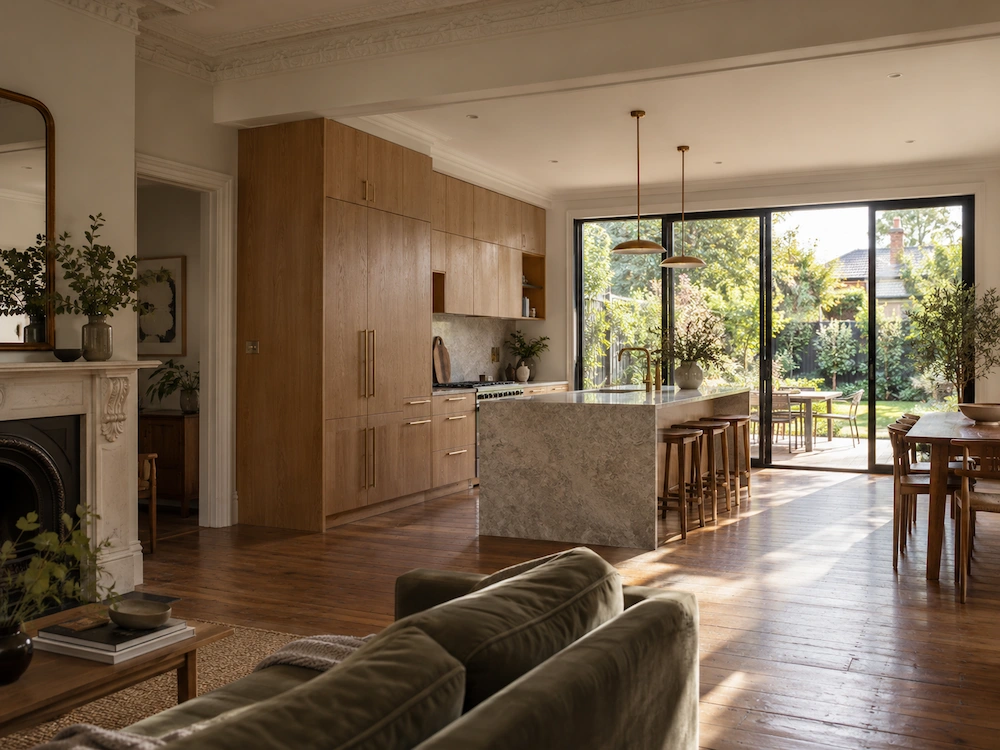
If you're planning to renovate your entire home, the question usually starts the same way:
How much is this actually going to cost?
The mistake is assuming you can answer that by adding together a kitchen, two bathrooms, flooring and paint.
Those are the parts you can see.
What often determines whether a Melbourne renovation lands closer to $150,000, $300,000 or $500,000+ is what is happening behind the walls, underneath the floors and inside the existing structure.
Can the current layout stay?
Are load-bearing walls moving?
Does the house need rewiring or replumbing?
Are the stumps, bearers and joists sound?
Are you renovating one bathroom or three?
Are you staying within the existing footprint or building out?
And once everything is finished, are you expecting a practical, durable renovation or a highly detailed premium home?
Those questions matter enormously in established Melbourne suburbs where older homes often combine beautiful architecture with ageing services, unusual construction, restricted access and decades of previous alterations.
That is why Level A Builders does not try to turn an online renovation calculator into a quote.
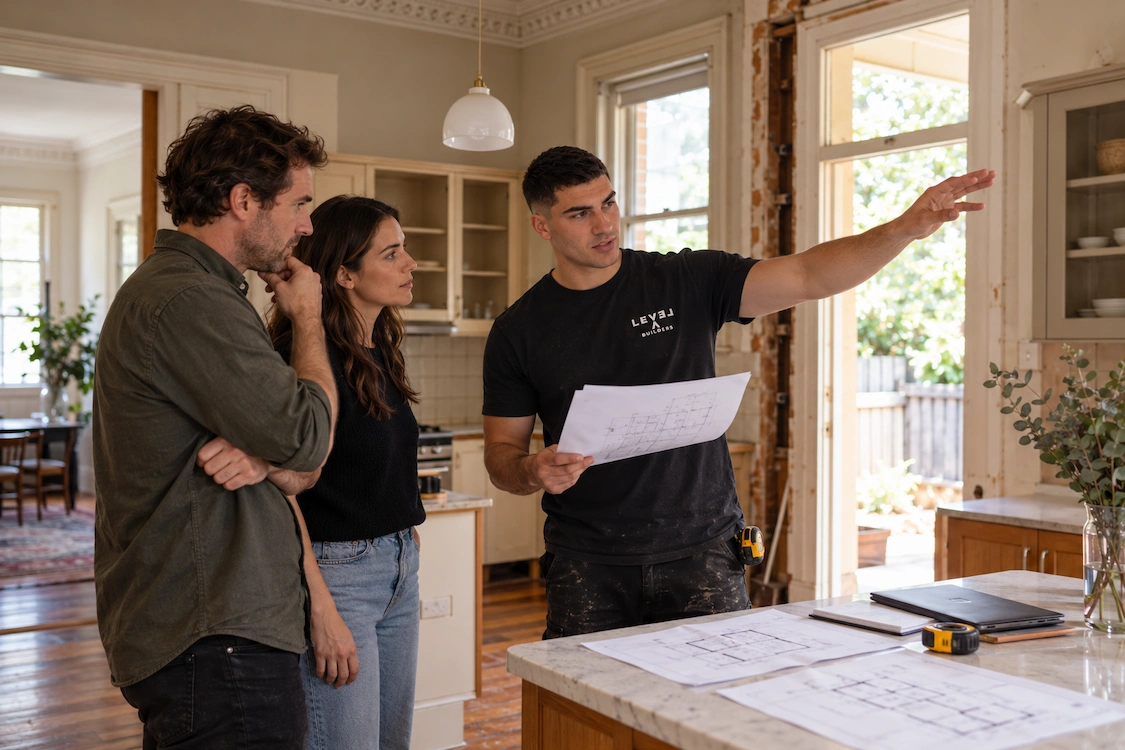
When you enquire about a full-house renovation, Jake personally inspects the property.
As the owner of Level A Builders, a qualified carpenter and a qualified waterproofer, Jake can assess what is worth keeping, what genuinely needs changing and what the proposed renovation is likely to involve before the scope is locked in.
That is where an online estimate starts becoming a real renovation plan.
What Does a Full-House Renovation Actually Include?
There is a major difference between refreshing every room in a house and fundamentally rebuilding how that house functions.
A largely cosmetic whole-home renovation might include:
- Painting throughout
- New flooring
- Updated lighting and power points
- New cabinetry
- A straightforward kitchen renovation
- One or two bathrooms within similar layouts
- Minor carpentry and plaster repairs
- New fixtures and finishes
A comprehensive renovation can go much further:
- Removing or relocating internal walls
- Creating open-plan kitchen, dining and living areas
- Installing structural steel and new framing
- Restumping or repairing the subfloor
- Rewiring the home
- Replacing or relocating plumbing
- Renovating multiple bathrooms and ensuites
- Rebuilding the laundry
- Installing custom joinery
- Improving insulation and thermal performance
- Replacing windows and doors
- Upgrading heating and cooling
- Modifying the roof structure
- Adding a rear or upper-storey extension
That is why two homeowners can both say:
"We want to renovate the whole house."
…and be talking about two completely different construction projects.
A structurally sound three-bedroom home receiving new finishes is not the same job as an older period home being opened up, rewired, replumbed and extended.
The floor area may be similar.
The cost will not be.
Full-House Renovation Costs in Melbourne: 2026 Guide
For early planning, these broad ranges are more useful than a single "average renovation cost".
| Renovation Scope | Broad Indicative Investment |
|---|---|
| Cosmetic whole-home renovation | $120,000–$180,000 |
| Comprehensive / structural renovation | $200,000–$350,000+ |
| Premium renovation with extensions | $350,000–$700,000+ |
| Large or highly complex transformation | Potentially above $700,000 |
These figures are indicative planning ranges only, not quotations.
Broad Melbourne renovation benchmarks can also sit around $1,500–$3,500 per square metre depending on the type of work, existing conditions and finish level, while complex extension work can move significantly higher.
But cost per square metre should be treated carefully.
A 160 m² house with good foundations, a sensible layout and one bathroom is a completely different proposition from a 160 m² period home requiring two new bathrooms, structural wall removal, rewiring, restumping and a rear extension.
The floor area did not change.
Almost everything affecting the construction cost did.
What tends to keep the renovation closer to the lower end?
Generally:
- The existing structure is sound
- Few walls are being moved
- Kitchen and bathroom services remain in similar positions
- Major electrical and plumbing upgrades are limited
- Site access is straightforward
- Existing floors or architectural elements can be retained
- The finish level is considered rather than highly bespoke
What tends to move the renovation toward the upper end?
Typically:
- Significant structural reconfiguration
- Rear or upper-storey additions
- Multiple bathrooms and ensuites
- Premium stone and custom joinery
- Extensive electrical or plumbing upgrades
- Restumping or structural remediation
- Difficult site access
- Complex roof alterations
- Older homes with hidden existing conditions
- Extensive heating, cooling, insulation or glazing upgrades
The difference between those scenarios can be hundreds of thousands of dollars.
Which is why the better question is not:
"What does a house renovation cost?"
It is:
"What does this house need to become the home we actually want?"
The Biggest Cost Drivers in a Melbourne Whole-Home Renovation
1. Structural Changes and Layout
Changing paint colours is inexpensive compared with changing load paths.
Removing a wall between your kitchen and living area may involve:
- Temporary support
- Demolition
- Structural assessment
- Steel or timber beams
- New framing
- Ceiling repairs
- Flooring repairs
- Electrical relocation
- Plumbing relocation
- Changes to cabinetry and finishes
If new floor area is being added, the project moves into another category again.
Ground-floor extensions in Melbourne can broadly move into the $2,800–$3,500 per square metre range before premium fit-outs and other project-specific costs are considered.
You can read more about what goes into that process on our house extensions page.
The important point is this:
Not every wall needs to disappear simply because open-plan living looks good on a floor plan.
Structural work should earn its cost by materially improving how the home functions.
Sometimes a large opening completely transforms the property.
Sometimes retaining part of a wall, working around the existing structure or changing the furniture and joinery layout achieves almost the same result without unnecessary structural expense.
That judgement is part of the value of having an experienced carpenter inspect the house before the design runs away from the budget.
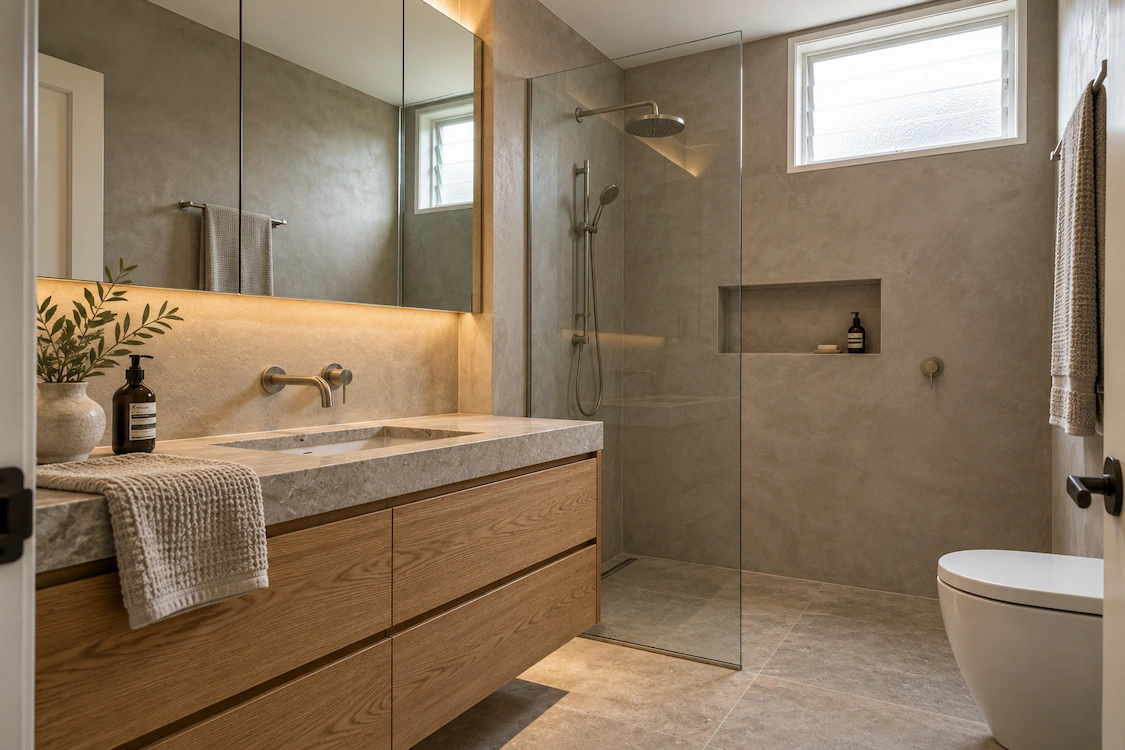
2. Bathrooms, Ensuites and Waterproofing
Bathrooms are among the most expensive rooms in a house on a square-metre basis.
A relatively small room can involve:
- Demolition
- Plumbing
- Electrical
- Carpentry
- Substrate preparation
- Waterproofing
- Screeding
- Tiling or microcement
- Joinery
- Glazing
- Fixtures
- Ventilation
- Painting and finishing
A complete bathroom renovation in Melbourne can broadly sit around $15,000–$35,000, while larger or highly detailed bathrooms can move materially higher.
Across two bathrooms, an ensuite and a laundry, wet areas can quickly become one of the biggest parts of the entire renovation budget.
And this is one area where the cheapest detail can become the most expensive mistake later.
Water does not care how much the tiles cost.
If the substrate, falls, junctions, penetrations or waterproofing system are wrong, the room can still fail.
That is one of the reasons Level A Builders' approach is different.
Jake is both a qualified carpenter and qualified waterproofer.
Instead of treating framing, substrate preparation and waterproofing as isolated responsibilities, those details can be considered together from the start.
That means less opportunity for the familiar:
"That's the tiler's problem."
"That's the waterproofer's problem."
"That's the builder's problem."
There is one accountable point of contact.
3. Kitchen, Joinery and Spatial Flow
A kitchen can broadly range from the mid-five figures into $50,000–$80,000+ territory once the project involves premium cabinetry, stone, appliances, major layout changes or substantial building work.
But the biggest kitchen question is not:
Which benchtop should we choose?
It is:
Should the kitchen stay where it is?
Moving it might completely transform the way the house functions.
It can also affect:
- Plumbing
- Electrical
- Ventilation
- Structural walls
- Flooring
- Ceilings
- Lighting
- Adjoining rooms
For some properties, relocating the kitchen is absolutely worth it.
For others, retaining its general location and spending the budget on better cabinetry, storage, natural light and circulation produces the stronger result.
You can see more about how Level A approaches these decisions on our kitchen renovations page.
The important thing is to treat the kitchen as part of the entire house rather than designing it in isolation.
4. Electrical, Plumbing, Heating and Cooling
Older homes often reveal their age through the systems you cannot see.
Once walls and floors begin opening up, a renovation may uncover:
- Ageing pipework
- Insufficient electrical capacity
- An outdated switchboard
- Poorly located power points
- Old wiring
- Inadequate ventilation
- Inefficient heating and cooling
- Limited insulation
- Services running directly through areas being reconfigured
Indicative figures for a full-house rewire alone can fall around $9,500–$24,000, depending on the property and scope.
Once plumbing, additional circuits, lighting, data, heating and cooling are added, services can become a substantial part of the overall investment.
This is one reason a house that looks perfectly reasonable at first glance can behave very differently once renovation work begins.
The expensive parts may not be visible yet.
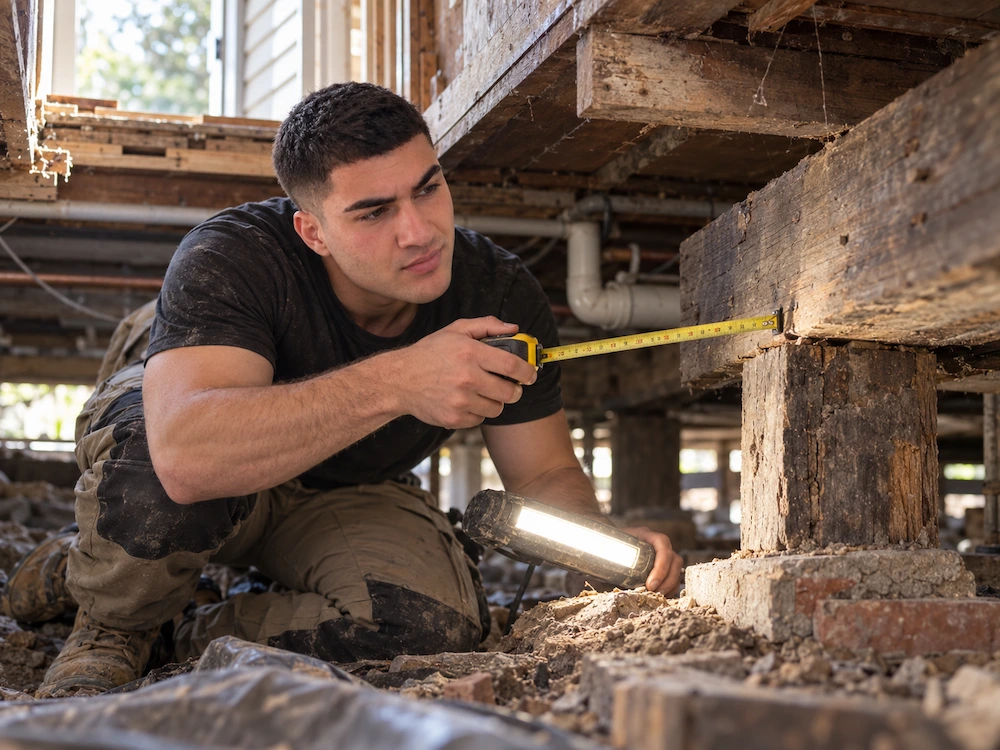
5. What Is Under the Existing House?
In older Melbourne homes, the hidden cost is sometimes literally underneath you.
Stumps settle.
Timber deteriorates.
Moisture reaches areas it should not.
Floors move.
Bearers and joists may have been altered during previous renovations.
Access can be extremely restricted.
Broad Victorian restumping figures can range from approximately $8,000 to $35,000, depending on the size of the home, access and the extent of the work.
That is not a small budget adjustment.
It can equal the cost of an entire room renovation.
Which is why Jake's property inspection matters.
A renovation quote built entirely around the finishes you want without considering the structure supporting those finishes is not really a renovation plan.
It is a wishlist.
Cosmetic Renovation vs Structural Renovation
The simplest way to understand the difference is to compare what is actually changing.
| Area | Cosmetic Renovation | Comprehensive / Structural Renovation |
|---|---|---|
| Layout | Mostly retained | Walls moved or removed |
| Kitchen | Existing zone retained | Relocated or structurally opened up |
| Bathrooms | Similar fixture locations | Reconfigured or enlarged |
| Electrical | Selected upgrades | Extensive upgrade or rewire |
| Plumbing | Localised | Significant relocation or replacement |
| Structure | Minimal intervention | New beams, framing or foundations |
| Floor area | Existing footprint | Possible rear or upper extension |
| Finishes | Standard to mid-range | Mid-range to premium or bespoke |
| Existing-condition exposure | Lower | Higher |
Understanding which side of that table your project sits on is far more valuable than chasing an average Melbourne renovation price.
Why Renovation Budgets Blow Out
Most homeowners are not frightened by the fact that a serious renovation costs money.
What they fear is agreeing to one number and watching it slowly become another.
The pattern is familiar.
A quote comes in lower than expected.
The scope sounds reasonable.
Construction begins.
Then the exclusions start appearing.
The electrical upgrade was not included.
The wall is structural.
The bathroom allowance does not cover what was actually selected.
The floor underneath needs repairing.
Moving the plumbing costs extra.
The builder assumed one thing.
The homeowner assumed another.
And halfway through the renovation, nobody is talking about the original price anymore.
Level A Builders approaches that problem differently.
Jake personally walks through the property and considers:
- What can remain
- What should be replaced
- Structural implications
- Wet areas
- Existing services
- Site access
- Existing deterioration
- Finish expectations
- Layout priorities
- Likely unknowns
The objective is to identify as many meaningful decisions as possible before the scope is locked in.
From there, the project is documented around an agreed scope.
If something changes, extra work and cost do not simply proceed and appear later on the bill.
Changes require prior written approval.
That does not mean an older home can never reveal something genuinely concealed.
No responsible builder can guarantee what is physically hidden behind every wall before it is opened.
The difference is how those situations are handled.
A genuine unknown should become a documented decision.
Not an open-ended invoice.
What Is Different About Level A Builders?
| Common Renovation Frustration | Level A Builders |
|---|---|
| Salesperson quotes the job, someone else runs it | You deal directly with Jake |
| Scope is vague before construction | Scope is developed around the actual property |
| Extra costs appear without warning | Variations require prior written approval |
| Builder and waterproofer blame each other | Jake is a qualified carpenter and qualified waterproofer |
| Updates are scattered across texts and emails | Quotes, invoices, schedules and approved changes are kept in a live project portal |
| Completion date keeps moving | $1,000 back for every week late when delays are within Level A Builders' control |
| Homeowner is left managing technical requirements | Jake assesses and coordinates what the specific scope requires |
The aim is not to pretend renovating an existing home is simple.
It is not.
The aim is to put one accountable person in front of that complexity.
You can learn more about Jake and the way Level A operates on our About page.
How Much Should You Budget for Bathrooms and Wet Areas?
For early planning:
| Wet Area | Broad Indicative Guide |
|---|---|
| Standard bathroom / ensuite | $15,000–$35,000+ |
| Laundry | $10,000–$19,000+ |
| Premium custom bathroom | Can move substantially above $35,000 |
A house containing two bathrooms, an ensuite and a laundry can therefore absorb a significant amount of the renovation budget before the kitchen or structural work is considered.
Fixture placement matters too.
Keeping a toilet, shower and vanity close to their existing plumbing positions can reduce construction work.
Moving them may create a dramatically better bathroom.
Neither approach is automatically right.
The question is whether the additional investment produces a better enough result to justify it.
The goal is not simply to spend less.
It is to understand what you are spending money on and why.
What Could a Full-House Renovation Cost in Different Melbourne Homes?
These examples are deliberately broad.
They are not suburb price lists.
They show how dramatically the home itself and the proposed scope can change the budget.
Brighton: Larger Home + Multiple Wet Areas + Rear Extension
A larger Brighton home involving:
- New kitchen
- Three bathrooms
- Laundry
- Electrical upgrade
- Plumbing upgrade
- Heating and cooling
- Rear extension
- Premium finishes
could reasonably move into an indicative $350,000–$600,000+ range.
The actual number would depend heavily on extension size, existing conditions and specification.
If you are renovating in the area, see our dedicated Brighton renovations and carpentry page.
Toorak: Premium Whole-Home Transformation
Larger homes, extensive custom joinery, premium fixtures, intricate detailing and significant structural changes can push a whole-home renovation into the $500,000–$700,000+ range.
At that level, specification decisions multiply quickly across a larger house.
One material upgrade may appear minor.
Repeated across cabinetry, bathrooms, flooring, hardware and joinery, it becomes substantial.
Essendon: Character Home Renovation
An Essendon period home may involve:
- Retaining original character
- Upgrading ageing services
- New kitchen
- Two bathrooms
- Laundry
- Restoring period features
- Improving the rear living areas
Broad research benchmarks suggest substantial renovations of this nature can sit around $250,000–$480,000, with extensions increasing the investment further.
Yarraville: Weatherboard Renovation
A smaller Yarraville weatherboard may have less floor area but carry different structural risks.
A comprehensive internal renovation involving:
- Subfloor work where required
- New kitchen
- Bathroom
- Electrical upgrades
- Plumbing upgrades
- New finishes
- Better storage and layout
may broadly fall around $150,000–$300,000, depending on the condition of the house and the amount of structural work involved.
These examples are not quotations.
A well-maintained property in one suburb may need significantly less structural work than a deteriorated house somewhere else.
The building matters more than the postcode.
Level A Builders services homeowners across Greater Melbourne. You can view our broader Melbourne service areas here.
How Much Contingency Should You Allow?
Existing homes contain unknowns.
That does not mean the budget should be vague.
It means risk should be acknowledged.
Broad renovation guidance commonly suggests allowing around:
- 10–15% for relatively straightforward projects
- 15–20% for substantial whole-home renovations or extensions
- 20–25% where older or character properties carry greater concealed-condition risk
If your working renovation budget is $250,000, for example, reserving another $25,000–$50,000 may be more sensible than allocating every available dollar to visible finishes before demolition starts.
Contingency is not an invitation to spend more.
It is a financial buffer between your project and the parts of an existing house nobody can fully inspect while they remain covered.
The more thoroughly the property and scope are assessed before construction, the more intelligently that risk can be managed.
How Long Does a Full-House Renovation Take in Melbourne?
There is no responsible universal timeframe.
Scope controls the program.
Broad planning benchmarks suggest:
- Cosmetic whole-home renovations may sometimes take around 6–10 weeks
- More substantial renovations may move into the 3–4 month range
- Genuine whole-house structural renovations frequently require around 5–7 months
- Larger projects involving extensions, multiple wet areas and significant structural work may take 6–9 months or longer
Those are indicative construction periods rather than promises.
The property, design, structural requirements, selections and overall project scope all influence the final schedule.
What changes with Level A Builders is what happens once an agreed contract schedule exists.
If the project runs past that agreed schedule for reasons within Level A Builders' control, you receive $1,000 back for every week late.
That turns the completion date from a vague aspiration into a commercial commitment.
What About Permits and Compliance?
You should not have to become a building-regulation expert just to renovate your home.
What is required depends on the actual scope.
Changing internal finishes is very different from removing structural walls or adding an extension.
Jake assesses that during the initial property review and coordinates the relevant requirements for the project.
The same applies to waterproofing.
It is not something that should be treated as paperwork at the end of a bathroom renovation.
It begins with how the room is designed and built underneath the finished surfaces.
The homeowner should be able to focus on the home.
The builder should manage the building process.
Why Homeowners Work Directly With Jake
A whole-home renovation can involve hundreds of decisions.
The last thing you need is to repeatedly explain those decisions to different people.
With Level A Builders, Jake remains your direct point of contact from the initial property review through to final handover.
There is no salesperson who disappears once the contract is signed.
There is no detached project manager trying to reconstruct decisions they were never involved in.
Qualified Carpenter
Structural alterations, framing, floors, existing timber conditions, openings and joinery interfaces can be assessed by someone who understands how the building physically goes together.
Qualified Waterproofer
Bathrooms and wet areas are considered as complete building systems rather than simply a collection of tiles and fixtures.
Fixed Scope and Written Variations
The agreed scope is documented.
Additional work or cost does not proceed without prior written approval.
Live Project Portal
Quotes, invoices, schedules and approved changes are kept transparently in one place.
$1,000-Per-Week Timeframe Guarantee
If Level A Builders runs beyond the agreed contract schedule for reasons within its control, the client receives $1,000 back for every week late.
These systems cannot remove every unknown from renovating an existing home.
They can remove a large amount of the uncertainty around who is responsible for managing it.
Why an Online Renovation Estimate Can Never Be Your Final Quote
Online guides are useful for answering one question:
Is our budget roughly aligned with what we want to do?
They cannot see:
- Your stumps and subfloor
- What is behind the plaster
- Whether wiring needs replacement
- How the roof is framed
- Whether existing floors can be saved
- How trades can access the property
- Which walls you want moved
- How much custom joinery you expect
- What fixtures you will select
- Whether your finish level is mid-range or premium
An online calculator cannot stand in your hallway and say:
Keep this.
Replace that.
Opening this wall will transform the house.
Moving that one probably isn't worth the cost.
That judgement is where a useful renovation scope comes from.
Every financial figure in this guide should therefore be treated as a broad indicative planning figure only.
Material pricing, labour, access, site conditions, selections and scope vary from property to property.
A fixed-scope quote requires Jake to inspect the home and understand what you actually want to achieve.
What Should You Prepare Before Meeting Jake?
You do not need to have every tap, tile and handle selected.
It helps to know four things.
1. Which Rooms Are Changing?
Think about the kitchen, bathrooms, ensuite, laundry, bedrooms and living areas you want included.
2. Do You Want to Change the Layout?
Are you happy with the current footprint?
Or are you considering open-plan living, larger openings, additional rooms or an extension?
3. What Level of Finish Are You Aiming For?
There is a significant difference between a durable, carefully detailed mid-range finish and extensive custom joinery, stone and premium fixtures throughout.
Neither is automatically right or wrong.
Your scope simply needs to reflect your expectations.
4. What Is Your Realistic Budget Envelope?
You do not need to know the final price before the inspection.
That is the point of assessing the property.
But knowing whether your comfortable investment level is closer to $150,000, $300,000 or $500,000+ lets Jake frame the discussion around what is realistically achievable.
That is far more useful than designing a $600,000 transformation and discovering later that the available budget is $250,000.
So, How Much Will Your Melbourne Full-House Renovation Cost?
For broad 2026 planning:
$120,000–$180,000 A largely cosmetic whole-home renovation where the house is in relatively good condition and structural intervention is limited.
$200,000–$350,000+ A comprehensive renovation involving multiple major rooms, services upgrades and meaningful structural changes.
$350,000–$700,000+ A substantial transformation involving extensions, multiple premium wet areas, extensive structural work and higher-end finishes.
Those numbers should help you answer:
Is our budget broadly realistic?
They cannot answer:
What will our home actually cost to renovate properly?
That requires someone to walk through the property, inspect what already exists, understand what you want to change and decide what should be retained rather than automatically demolished.
That is where Jake starts.
You can also view examples of Level A Builders' work and approach on our projects page.
Frequently Asked Questions About Full-House Renovation Costs in Melbourne
How much does it cost to fully renovate a house in Melbourne?
A full-house renovation in Melbourne may broadly range from around $120,000–$180,000 for largely cosmetic work, $200,000–$350,000+ for a comprehensive renovation, and $350,000–$700,000+ for larger projects involving extensions, premium finishes and extensive structural work.
These are indicative planning ranges. A fixed quote depends on the property's actual condition and proposed scope.
How much does a house renovation cost per square metre in Melbourne?
Broad renovation benchmarks can sit around $1,500–$3,500 per square metre, but square-metre pricing becomes less reliable as structural work, bathrooms, kitchens, services upgrades and extensions increase.
The condition and scope of the individual property matter more than floor area alone.
What is the most expensive part of a house renovation?
There is no single answer, but major cost drivers commonly include structural changes, extensions, bathrooms, kitchens, electrical and plumbing upgrades, custom joinery and hidden structural remediation.
Wet areas are particularly expensive per square metre because numerous trades and technical systems are concentrated within a small area.
Is it cheaper to renovate without changing the layout?
Generally, yes.
Retaining existing walls and keeping kitchens and bathrooms close to their current plumbing positions can reduce structural, electrical and plumbing work.
However, a layout change may still be worth the additional investment if it significantly improves how the home functions.
How long does a complete home renovation take?
Smaller cosmetic renovations can sometimes be completed within a few months, while comprehensive whole-home renovations commonly require five to seven months or more.
Large structural renovations and extensions may require six to nine months or longer, depending on the scope.
How do I get an accurate renovation price?
The most reliable way is to have the property inspected.
Jake reviews the existing structure, wet areas, services, access, desired layout and finish expectations before Level A Builders develops the project scope.
Online price guides should be used to establish a broad budget range, not as a substitute for a property-specific quote.
Ready to Find Out What Your Renovation Will Actually Involve?
If you are planning a full-house renovation in Brighton, Toorak, Essendon, Yarraville, Prahran, Albert Park, Armadale or elsewhere across Greater Melbourne, you do not need another renovation calculator.
You need to understand your house.
Jake will personally walk through the property with you, assess the existing structure and wet areas, discuss how you want the home to function, and identify what is worth retaining versus what genuinely needs changing.
From there, Level A Builders can define the project around clearer expectations for scope, investment, timing and responsibility.